Monday, October 5, 2015

Race Car Or Track Day Car Storage In Grandville, MI


We have limited spaces available, for storage of your special interest, track day car, or race car.  Move in on November 1st.  Month to month.  Close to downtown Grandville, MI area, and local freeways.  Very clean, dry, and secure building.  Call:  616-366-3973, for further information.


Visit us on the web at:  http://www.gearheadzproducts.com
 

Sunday, June 7, 2015

Maximize Your Race Cars Ignition System

We have been around race cars, and performance street cars for many, many years.  One of the biggest soures for increased performance, and problems, is the cars ignition components.  Keeping the system fully functional is simply a matter many times of staying ahead of problems that are going to occur.  Ignition wires are good for only a few years, at best, considering the conditions that they operate in.  Headers are extremely hot, and burnt wires are not uncommon, which usually means a buying a whole new set of wires, and worse yet, pulling off the race track early.   We devleoped these simple but effective plug wire covers, to go on the wire at the spark plug end.  They really work, and are less than a new set of wires.


We saw a race car that would not run about ten years ago, on the most humid night of July.  The next night we popped the hood, and started it up.  You could see electric arcs coming off the plug wires, in the dark.  The wires were made by a well known company, and did not have that many laps on them.  However, they were more than a couple years old, and simply no good at that point.
The first and most basic thing to do with any race car distribuor, is maximize the spark advance curve.  Ideally you do not want the advance to come in before 1,000 RPM (at idle), but you want to have it all in by 4000 RPM, or less.  This simply translates into horsepower that your engine has, but is not using.  The best way to know you advance curve is to put the distributor in a Sun or King distributor machinhe, and plot out the curve.  These machines are getting harder to come by, since they are no longer being produced.  The old ones that are still operating, are not as acurate as they once were.  Find an engine builder who can work with you on this, and you will not regret it.  The curve can be modifed by various spring kits that are available from after market companies.  However, we have found that the chart on the back of the package (if there is one) is not always true to what is seen on the machine, during a test run.  The curve below shows some results were were happy with, after testing a number of different spring kits for a circle track customer recently. 


Even a brand new distributor from one of the well known companies does not include a spring kit, which is sold seperately.  Keep in mind they are selling to everyone from drag racers, to steet rodderss, to road racers.  Each has different requirements.  Vacuum advance is good for a steet vehicle.  On a race distributor we also lockout the vacuum advance unit, so there is no chance of the spark advance floating around, during acceleration.  So many racers just but a new distributor, and assume everything is OK.   Below is a picture of our Sun distributor machine, which has been completely rebuilt by the Parmamont Distributor Machine Co.


We have 11 degrees of advance at the distributor, in the graph above.  Since the distributor runs at 1/2 the crank shaft speed, we will have 22 degrees of total advance with the distributor installed.  That means that we will need to set the rest of the advance with a timing light, at the crankshaft.  If we want 38 degrees of total advance, then the initial timing will be set at 16 degrees.  22 degrees plus 16 degrees equals a total of 38 degrees advance.
Knowing about spark advance is one of the basics, so make sure you fully understand what is going on with your cars distributor.  keep the plug wires fresh, and protected.  Replace them before trouble occurs.  Set  your cars timing with a gun at full advance, to make sure you are getting maximum horsepower.  Being off by a few degrees the wrong way can result in detonation, which can have disaterous results. 

Visit us on the web, for all your garage needs.  We are glad to help you out, however we can.

http://gearheadzproducts.com/distributorsplugwiresandaccessories.aspx


Monday, May 25, 2015

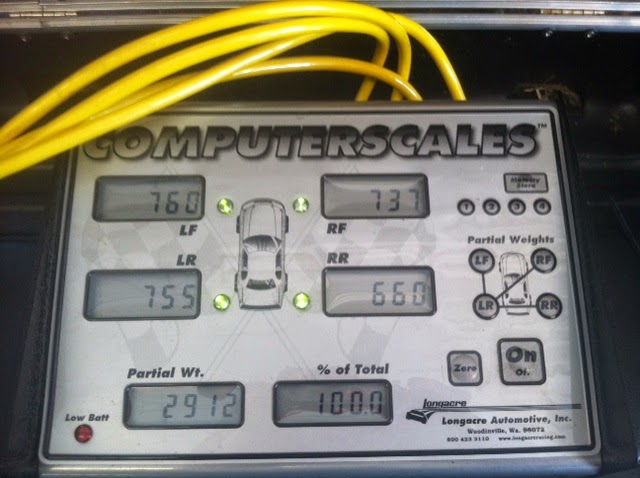
Scaling The Camaro SCCA GT-2 Road Race Car

When scaling any race car, there are a few simple but important steps to follow.  We use Longacre electronic scales, with each load cell marked for the the corner of the car it goes to. 


The first step is to level the scales.  We purchased an extendable bubble level from Menards, that works great for the job.  Each scale should be leveled, and then the four load cells checked against each other.  Without doing this, you will never get an accurate reading of your cars corner weights.  We have seen guys scales cars in the dirt at the track, on race day.  The shop floor is the best place to do this, and most floors are not all that level either. 

   
The car should be placed in gear so it will not roll.  In addition, we put some pieces of steel against the tires, to keep the race car firmly in place.  Tire pressures should be set as they are for race day.  Hoosier recomends 23 to 26 lbs. cold for our compound, so we have been using 24 pounds as our starting point.  After that, we add bags of salt to the drivers seat.  The salt bags are each weighed, to insure that we get the same weight as the driver will bring to the seat.  This makes it easier for your "hot shoe" to participate in the scaling process as well.  Before adding the salt, we set the corner heights to the rules, to get close to our starting point, the work to be done.
 
 
Our experience from the circle track days has been that adding a driver to the vehicle takes wedge (LR/RF) percentages from the static settings.  With the road race car, we prefer to have the LF/RF weights a close to equal as we can get.  If you are scaling a roundy roundy racer, make sure the sway bar is not preloaded, which will throw off your readings.  The bar should be fully backed off for scaling.  Due to our heavy driver, all the balast has been removed from our Howe Port City vehicle (former ASA racer).  You may need to add some, to bring the car up to minimum which in our case is 2830 lbs, for GT-2.
You will need to make corner corrections, to get the car where you want it.  With coil over shocks, this is really easy.  Make adjustments at all four corners.  For example if you need a little more LR/RF, then put a turn in the LR/RF, and take a turn out of the RR/LF.  We run Pro Shocks, with double adjustables on the front, and rebound adjustables on the rear.  Find someone to dyno your shocks, and make sure that there is no abnormalities in the curve, which can be seen in a computer print out from the dyno run.
Our car has gotten a little loose a couple time, in tight right hand turn situtations.  We went a little softer on the front springs, that what was in the car when we received it.  This is really the fun part of the whole thing, making small adjustments, and seeing how they affect the feel of the vehicle.


http://www.gearheadzproducts.com


Thursday, December 25, 2014

Burned Spark Plug Wires Can Be A Race Day Problem

It has to happen sooner or later.  You are up front, leading the race, when you feel the engine start to miss.  The car in the mirror keeps getting bigger, and bigger.  Thermal plug wire covers are an inexpensive solution to prevent headers from taking out your plug wires.   The vibration under the hood of a race car is extreme.  These easy to install covers will keep you from having to buy a whole set of plug wires, to replace just one that is burned.  Rated to with stand temperatures of up to 1200 degrees F, these things really work.  Take a look, they are available for four, six, and eight cylinder racing engines: 


Typical installation on a four cylinder Formula Continental racing engine. 


Wire seperators help to keep everything in line, when the high speed vibrations starts.


Thursday, November 27, 2014

A Look Under The Hood Of Our GT2 SCCA Road Race Camaro

This car is a GT-2 legal SCCA race car, that can also be entered  as a TA-2 car, in the professional Trans Am series.  Our Howe/Port City car is an ex-ASA perimeter chassis, circle track race car.  It has  an actual series LS1 motor, that runs factory ignition coils, 10.5 compression ratio, dry sump oil pan, 180 headers, and a GM factory ECU. The sealed engines that were supplied for the ASA series went from Chevrolet, to Lingenfelter Performance Engineering (LPE), in Decatur, IN.  You will not find that they have much interest in them now days, but we have received good support from Schwanke Engines, in Springfield, MN.  They are doing a number of motors for the professional Trans Am Series (both LS-1, and LS-3), and offer packages that include everything from short blocks, up to complete, ready to race motors.  Visit them at:
 
 
Our own shop offers a lot of automotive related accessories, as well.  We are stocking more race related items every day, and have just finished redoing a nearby industrial building, for our mail order business.  We have a lot of used parts that are very useable, as well  If you are new to track days, or SCCA racing, we will be glad to answer any questions, and assist you however we can.  Our toll free number is:  866-229-7939.  You can visit us on the web at: